I know… I'm terrible at this whole "regular blogging" thing. I have so many amazing stories and photos to share, not just about Africa, but other less exotic adventures as well. I've not given up- I'll get to them in due time.
Right now I feel I need to jump forward in the African Adventure for just a moment. I just learned that the International Union for Conservation of Nature has declared Africa's western black rhino officially extinct. It's extinction is mainly due to poaching for trophies and for their horns, which superstition holds is a cure for cancer, and to a general lack of conservation measures.
While in Tanzania, (the second half of our trip) we were fortunate enough to observe a solitary black rhino while on one of our game drives. It was a spectacular moment- I remember our guide being very excited. He said they were rare and extremely shy. They tended to chase off any other species in their general vicinity, and really didn't even like the company of their own kind. Our group was in awe of this majestic creature standing alone on the plain, browsing on leaves and twigs. We stayed and watched for a good half hour, until she disappeared into the brush.
I feel so incredibly saddened that another animal has been wiped off this earth, and so blessed to have had the opportunity to see one of these beautiful creatures with my own eyes, to have shared the experience with my father and step-mom, and now to be able to share my experience through this blog.
After reading of the fate of the black rhino, I went searching for my photos of that day. Poring through the photos of the rhino, I felt the weight of my experience and my eyes teared up. I remembered the peace on that plain, and the warm, dry wind that carried the faint sound of the black rhino as she lumbered slowly through the brush. I remembered how our camera shutters clicked wildly for a few moments and eventually tapered off to silence, amazement and a sense of gratitude for being able to view this animal that most may never see outside of a tv special, zoo.
My heart is heavy now knowing the black rhino will not be a part of our world any longer.
Showing posts with label safari. Show all posts
Tuesday, November 5, 2013
Monday, November 12, 2012
Back to Botswana
Over a year later I'm finally getting back to blogging about my African adventure with my father and step-mother. The memories are still so vibrant in my mind- I miss the sounds and smells of the African landscape. I would like to go back someday.
When I returned from my trip last year, I told many people about my experience (okay... anyone who would listen). The owner of the company I work for is a fantastic photographer, and so I told him he should go. Then I told the woman who had hired me for the job 15 years ago. She and her husband loved to travel, but had yet to experience a tour, much less one of such wild proportions. I gave her the website of OAT and they began planning. They've just left for their trip last sunday and I'm quite excited to hear about their experience in Africa. I hope it's as amazing as mine was.
So back to Botswana...
Game drives are fantastic. The whole experience is fantastic. At this camp we would have two guides and two vehicles divided among 14 travelers. After a hearty breakfast at dawn, we would head out. Our guides, Tuelo (Mr T, is what we called him) and Julius, were knowledgable and happy to answer any quesions we had about animals, Botswana, the culture, you name it. They loved what they did and it showed.
When I returned from my trip last year, I told many people about my experience (okay... anyone who would listen). The owner of the company I work for is a fantastic photographer, and so I told him he should go. Then I told the woman who had hired me for the job 15 years ago. She and her husband loved to travel, but had yet to experience a tour, much less one of such wild proportions. I gave her the website of OAT and they began planning. They've just left for their trip last sunday and I'm quite excited to hear about their experience in Africa. I hope it's as amazing as mine was.
So back to Botswana...
Game drives are fantastic. The whole experience is fantastic. At this camp we would have two guides and two vehicles divided among 14 travelers. After a hearty breakfast at dawn, we would head out. Our guides, Tuelo (Mr T, is what we called him) and Julius, were knowledgable and happy to answer any quesions we had about animals, Botswana, the culture, you name it. They loved what they did and it showed.
Mr T on the lookout.
It's difficult to gauge the size of this termite mound, but chances are it's bigger than you think.
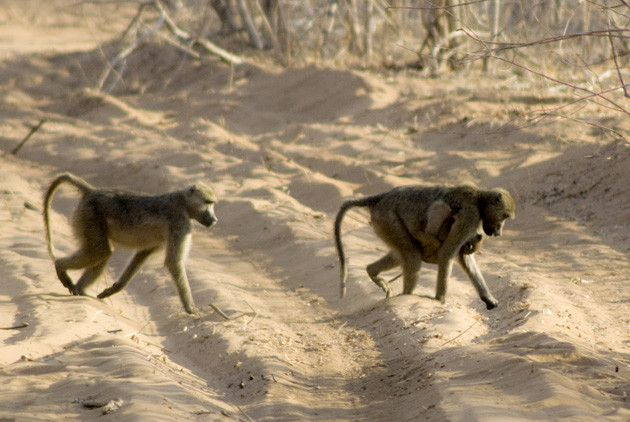
Many animals crossed our path as we drove. The sandy roads were not only traveled by us- elephants, baboons, warthogs, what-have-you. They used the heavily treaded trails to cut through the sharp, brambly terrain. It was not uncommon to have to stop and wait for passing families.
First spotting of a black backed jackal. Shy little guy... he steered clear of our noisy vehicles.
When this little one crosses, you wait for the others to follow. Last place you want to be
is between a mother elephant and her calf.
Mid morning we stop in an open area to enjoy a snack and a cup of tea or coffee. It's getting warm, and soon the animals will all find shade and lounge until the evening. Morning break gives us an opportunity to stretch our legs, find a vacant termite mound to relieve ourselves and get to know our fellow travelers.
After our break, we would take a leisurely drive back to camp, stopping to view impala, baobab trees, and many, many birds. The views are so different from what I'm used to. Everything is so much bigger, so much wilder, and so much more obviously dangerous.
A young male impala strutting his stuff.
Baobab trees jutting from the landscape in the distance.
Returning from our morning game drive, we freshen up and return to the common area to talk, have cold beverages and eat an amazing lunch, provided by the cooking staff. We were never left hungry, and the food was always delightful.
Dad takes a moment to flip through his photos and share some of the gems with the rest of the group.
Sunday, October 23, 2011
Our quarters while at Baobab Safari Lodge consist of individual thatched huts (not tents) that stretch across the edge of the hillside, following a rock-lined path. We were issued a key and told to be sure to lock our doors when we leave our rooms. Apparently the baboons occasionally play with the door latches and if they manage to jiggle the door loose, one might find one's undergarments, or "smalls" strewn across the property. Each room is fully equipped with a bed, flushable toilet, running water to a sink and shower, as well as a small desk. More importantly, each room comes complete with a can of mosquito repellant called Peaceful Sleep, a bug spray called DOOM, and a compressed air boat horn for medical emergencies. Thankfully the only one I didn't have to use was the horn.
I'm fairly certain the Peaceful Sleep was so named not only for it's ability to deter mosquitos from disturbing ones sleep but also because spraying the cloud of heavy, chemical mist onto ones body causes immediate gasping, drowsiness and eventual loss of consciousness.
Our mornings began at 5:30 with a "wake up call." The lodge hostess, a woman we called Auntie would walk along the path, stop at each room and play a drum until we yelled back with a cheerful "Good Morning!" Our breakfasts are hearty and delicious, and after we eat, we jump into our safari vehicles and head to the Chobe National Park, just a few minutes down the road.
The game drives are amazing. While there are designated roads, they are far from flat or smooth, and occasionally the vehicles will bog down to a slow, bumpy crawl in the fine Kalahari sand. Our guides and trip leader refer to the experience as an authentic "African massage." While in the park, we're treated to many animals. Elephants, baboons, groups of impala (called a "rank" of impala), kudu, warthogs and sable, to name a few.
Our mornings began at 5:30 with a "wake up call." The lodge hostess, a woman we called Auntie would walk along the path, stop at each room and play a drum until we yelled back with a cheerful "Good Morning!" Our breakfasts are hearty and delicious, and after we eat, we jump into our safari vehicles and head to the Chobe National Park, just a few minutes down the road.
The game drives are amazing. While there are designated roads, they are far from flat or smooth, and occasionally the vehicles will bog down to a slow, bumpy crawl in the fine Kalahari sand. Our guides and trip leader refer to the experience as an authentic "African massage." While in the park, we're treated to many animals. Elephants, baboons, groups of impala (called a "rank" of impala), kudu, warthogs and sable, to name a few.
A yellow baboon foraging for seeds and other goodies commonly found in elephant dung.
The male impala will keep a harem of up to 45 females. It's no wonder that he may be thin and exhausted by the end of the mating season.
The greater kudu- the male has horns which reach one full twist at around two years of age, and do not reach the full two and a half twist until they reach the age of six.
Both male and female sable antelope have long arching horns, reaching one meter in females and slightly longer in males. When threatened by predators they can use their horns quite effectively to protect themselves, occasionally killing big cats who hunt them.
Warthogs get their name from the "warts" on the sides of their face that act as shock absorbers when they butt heads during a fight.
Sunday, October 2, 2011
Elephantidae Loxodonta
... commonly known as the African elephant. The African elephant can be distinguished from it's Asian cousins by it's larger stature, bigger ears and by having two "fingers" or "lips" at the end of their trunk, as opposed to the Asian elephant's one. They can eat up to 450 kilos of plant matter per day but their digestive system only processes about 40% of it. In parts of Africa there is an overpopulation problem with elephants. Quite a quandary... what to do with an overpopulation of car-sized mammals that we went through so much effort to protect.
As many elephants as we saw, I never tired of watching them. The way they use their tusks and trunks to break down trees was fascinating- many of them had an expert understanding of leverage. Sadly we saw many areas where the elephant population had decimated the vegetation. There were entire orchards of indigenous trees that had been broken down to leafless stumps of brush that stood 4 feet high. The baobab tree in particular is a prime target for the elephant. During the dry season they become a staple because the soft, corky trunk stores large amounts of water.
Chewed up trees were a common sight in Botswana. Interestingly, elephant dung looks nearly identical in texture and color, owing to the fact that 60% of its makeup is undigested vegetation. We learned much about animal dung on this adventure... but that's a separate post in itself.
As many elephants as we saw, I never tired of watching them. The way they use their tusks and trunks to break down trees was fascinating- many of them had an expert understanding of leverage. Sadly we saw many areas where the elephant population had decimated the vegetation. There were entire orchards of indigenous trees that had been broken down to leafless stumps of brush that stood 4 feet high. The baobab tree in particular is a prime target for the elephant. During the dry season they become a staple because the soft, corky trunk stores large amounts of water.
Chewed up trees were a common sight in Botswana. Interestingly, elephant dung looks nearly identical in texture and color, owing to the fact that 60% of its makeup is undigested vegetation. We learned much about animal dung on this adventure... but that's a separate post in itself.
Elephants can live up to 80 years, with child bearing years being between the ages of 20 and 50 years on average. The mother generally carries the child for 22 months with each pregnancy bearing one calf. Time between pregnancies can range from two to four years. A group of elephants is called a "parade of elephants" and the little ones are usually in the center, protected by the adults. As a general rule, if a baby elephant can still walk under the adults' bellies, it's less than a year old.
We've all heard that elephants never forget. While that may not be entirely true, they do in fact have quite extraordinary memories. The ivory trade nearly wiped out the elephant population, bringing it's numbers down to only 600,000. In 1990, ivory sales was banned, but in some of the areas hardest hit by poachers, the elephants are still hostile toward humans. Twenty one years later, they would still flap their ears in irritation and trumpet angrily as we passed. I don't blame them.
Notably, the African elephant's ear mimics the shape of the African continent.
Interestingly, I learned that the legend of the elephant graveyard is generally a myth. It is true that the bones of old elephants are commonly found in groups, but the reason is not because they have some sense of burial rite or tradition. Elephants have 6 sets of teeth and as the forward set wears out, the next ones move forward, much like conveyor belt. As the elephant wears out it's last set, it must seek out softer foods, usually around bogs and marshes. The elephant will stay in that area until it can no longer eat, at which point it will starve to death.
I wish we had these signs in Los Angeles. It would make driving more interesting.
Wednesday, September 28, 2011
Botswana
This is Vitalis saving us from a falling tree. Okay, not really- but he would if the situation arose!
The sun was low in the sky as we drove up and by the time we made our way to the main meeting area in the lodge, it was beginning to set. Suddenly the weight of that moment in time brought such joy to my heart. I watched zebras come to graze and frolic, and cape buffalo wade across to the islands in the middle. I heard the elephants grumbling and snapping young trees, and baboons calling to each other as they settled in the trees for the night. That moment was a milestone in my world and a quintessential African experience. I was suddenly very aware of where I was... and it brought a tear to my eye.
Sunday, September 25, 2011
Johannesburg part II
Our first hotel (the broken shower one) was not to be where we would meet the rest of our party. We had arrived a day earlier than the rest, and due to the hotel being full, we were shuttled to another for a night. The next morning we arrived at the O.R. Tambo Protea Hotel where we would eventually join the rest of our group, who were just arriving from their layover in London.
The whole hotel is designed and decorated around air transport with wooden packing crates, airplane parts, even a flight simulator in the lobby. The bathrooms showed a hint of humor- I appreciated that.
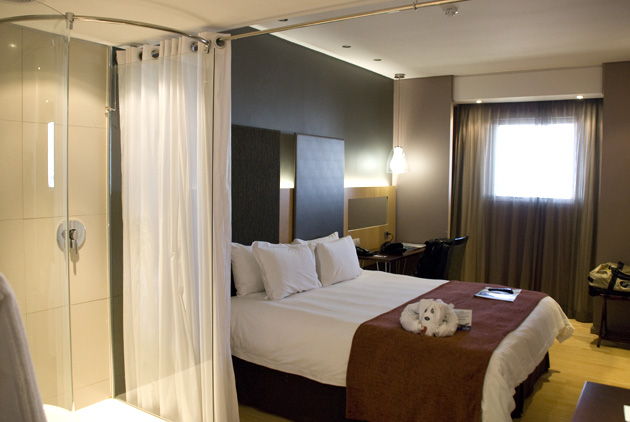
Clean, simple rooms at the O.R. Tambo Protea Hotel
There's an oxygen mask hanging near the toilet... NICE
Indeed- Oh Sheet!
We spent the afternoon hanging out by the pool and watching the airplanes come in to the airport across the highway. This was just the beginning of our Africa adventure.
But first things first . . .
Subscribe to:
Posts (Atom)